Why Graft Counts Are Often a Misleading Guide in Hair Transplant Surgery
In modern hair restoration, one of the most common questions patients ask is:
“How many grafts do I need?”
It is understandable why graft counts have become such a major focus. Many clinics advertise procedures primarily based on numbers — 2,000 grafts, 4,000 grafts, even 6,000+ graft sessions — often implying that larger numbers automatically translate into better outcomes.
However, experienced hair restoration doctors understand that graft counts alone are often a very poor predictor of the final cosmetic result.
Hair transplantation is not simply a numbers game.
A natural, aesthetically balanced result depends on far more than the quantity of grafts implanted.
At Young Hair Restoration, we believe patients should understand the broader factors that truly influence a successful hair transplant outcome.
⸻
What Is a Graft?
A graft, or follicular unit, is a naturally occurring group of hairs extracted from the donor area.
Each graft may contain:
• 1 hair
• 2 hairs
• 3 hairs
• occasionally 4, and 5 hairs
This means that:
• 2,000 grafts in one patient may contain 4,000 hairs
• while 2,000 grafts in another patient may contain only 3,000 hairs
Immediately, this demonstrates one major limitation of comparing graft numbers between patients or clinics.
Not all grafts are equal.
⸻
Why More Grafts Does Not Always Mean a Better Result
Many patients assume:
“If one clinic recommends 5,000 grafts and another recommends 2,500 grafts, the larger number must be better.”
In reality, this is often an oversimplification.
The appearance of density depends on many interacting variables, including:
• Hair calibre
• Hair colour
• Skin contrast
• Hair curl or wave
• Donor density
• Hair shaft thickness
• Hairline design
• Strategic placement- what areas need high density?
• Angulation and direction
• Existing native hair
• Crown characteristics
• Long-term donor management
A patient with thick, wavy, dark hair and low scalp contrast may achieve excellent cosmetic density with relatively modest graft numbers.
Conversely, a patient with very fine blonde hair and high scalp contrast may require substantially more grafts to achieve similar visual coverage.
⸻
Cosmetic Density vs Numerical Density
This is one of the most misunderstood concepts in hair transplantation.
The eye perceives “coverage” and “shadowing,” not graft counts.
An experienced doctor understands how to strategically create the illusion of density using:
• proper distribution
• layering
• transition zones
• macro-irregularity
• micro-irregularity
• direction control
• selective graft placement
Sometimes a carefully planned 2,000 graft procedure may appear more natural and aesthetically pleasing than a poorly designed 4,500 graft procedure.
⸻
The Dangers of Chasing Extremely High Graft Counts
One of the concerning trends in modern hair transplantation is the marketing of excessively large graft sessions.
In some cases, clinics aggressively pursue:
• 5,000+
• 6,000+
• even 7,000+ graft procedures
without adequate regard for:
• donor preservation
• long-term planning
• future hair loss progression
• scalp vascularity
• natural density gradients
This can create several problems.
⸻
1. Donor Overharvesting
The donor area is finite.
Every follicular unit extracted permanently reduces the donor reserve available for:
• future procedures
• corrective work
• crown restoration
• age-related progression
Overharvesting may lead to:
• patchiness
• see-through donor appearance
• moth-eaten extraction patterns
• inability to perform future restoration
Responsible donor management is one of the most important principles in modern hair restoration.
⸻
2. Poor Long-Term Planning
Hair loss is progressive.
A patient in their 30s may continue losing native hair for decades.
If too many grafts are aggressively used early:
• future density may become difficult to maintain
• isolated transplanted “islands” may develop
• crown expansion may expose planning limitations
• the patient may eventually lack sufficient donor supply
A successful hair transplant should not only look good today.
It should continue to age naturally over time.
⸻
3. Unnatural Density Distribution
Natural hair does not grow with uniform density across the scalp.
Some high-volume approaches attempt to densely pack large areas indiscriminately.
This may create:
• abrupt transitions
• unnatural wall-like hairlines
• excessive frontal density with weak midscalp support
• visually imbalanced outcomes
Naturalness is often achieved through restraint and strategic planning rather than maximal implantation.
⸻
Hairline Design Matters More Than Patients Realise
One of the most critical determinants of a natural result is hairline design.
Natural hairlines are not perfectly straight.
They contain:
• subtle asymmetry
• micro-irregularities
• varying follicular composition
• soft transition zones
An overly aggressive or excessively low hairline may consume enormous graft numbers unnecessarily while also appearing unnatural as the patient ages.
An age-appropriate, conservatively designed hairline often creates a far more refined and sustainable outcome.
⸻
Crown Restoration Requires Strategic Thinking
The crown is particularly graft-intensive.
Many patients underestimate how many grafts are required to create significant visual density in the vertex.
The crown contains:
• spiral patterns
• multidirectional angulation
• high light reflection
• large surface area
Attempting dense crown coverage too early can rapidly deplete donor reserves.
In many patients, prioritising the frontal scalp initially is the more strategic long-term approach.
⸻
Why Online Graft Estimates Are Often Inaccurate
Many patients send photographs requesting:
“How many grafts do I need?”
While rough estimates may sometimes be possible, photographs alone cannot fully assess:
• donor laxity
• donor density
• follicular composition
• miniaturisation
• scalp characteristics
• hair calibre
• progression risk
• long-term donor safety
This is why responsible doctors are often cautious about giving definitive graft numbers from images alone.
An in-person consultation remains essential.
⸻
The Most Important Goal: Naturalness
Ultimately, patients rarely walk past someone and think:
“That looks like 3,200 grafts.”
What people notice is:
• naturalness
• softness
• balance
• harmony
• age-appropriateness
The best hair transplants are often the ones that do not look like hair transplants at all.
⸻
A More Sophisticated Way to Think About Hair Restoration
Rather than focusing purely on graft numbers, patients should ask:
• Is the donor being managed responsibly?
• Does the design suit my age and future hair loss?
• Is the result likely to age naturally?
• Is the doctor prioritising long-term planning?
• Is the hairline soft and natural?
• Is the procedure individualised to my characteristics?
Hair transplantation is a combination of:
• surgical precision
• medical judgement
• aesthetic understanding
• long-term planning
It is not simply a race to implant the highest number of grafts possible.
⸻
Final Thoughts
Graft counts can be useful as one component of planning.
However, they should never be viewed in isolation.
A successful hair transplant depends on the quality of planning, execution, artistry, and long-term donor preservation — not merely the size of the session.
At Young Hair Restoration, every procedure is individually designed with a focus on:
• natural outcomes
• donor preservation
• long-term strategy
• and age-appropriate restoration
Because ultimately, the goal is not simply to implant more grafts.
The goal is to create hair that looks naturally yours.
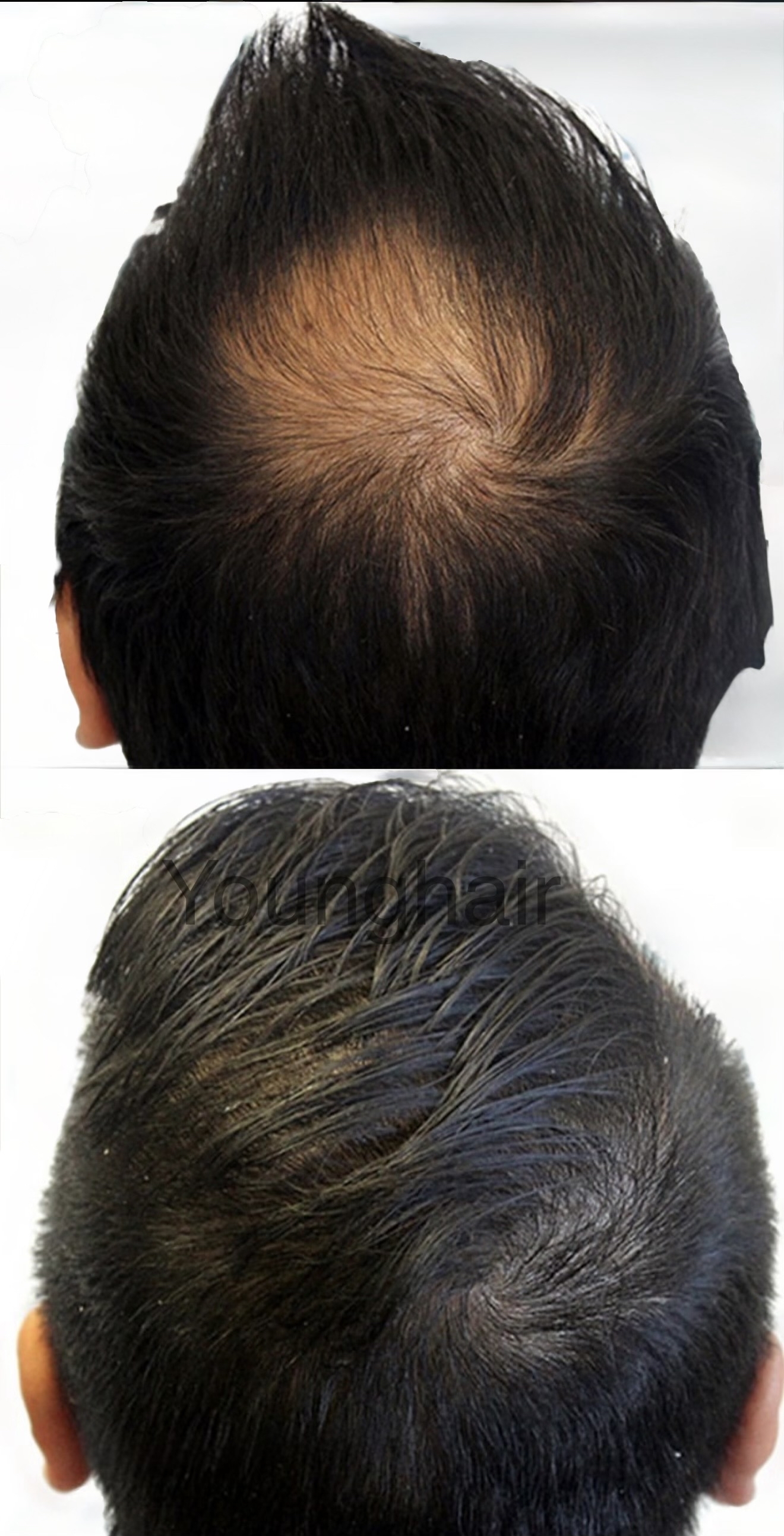
Case Example.
This patient was a Norwood 3V, coarse straight hair. The plan was to create a natural restoration and optical density of the crown. The optimal use of 2600 hairs that was placed to allow natural flow and overlap, shows that using smaller numbers of grafts can create high level results.
This is only possible with specific characheristics of hair and placement that allows thiis type of result to be possible.
Many times Dr Young sees crowns bthat are implanted with large numbers of follicles in some grid pattern with no real design or plannijng.