What Is a 3D Hair Transplant? Direction, Angle and Natural Hair Flow
A natural-looking hair transplant depends on much more than the number of grafts implanted.
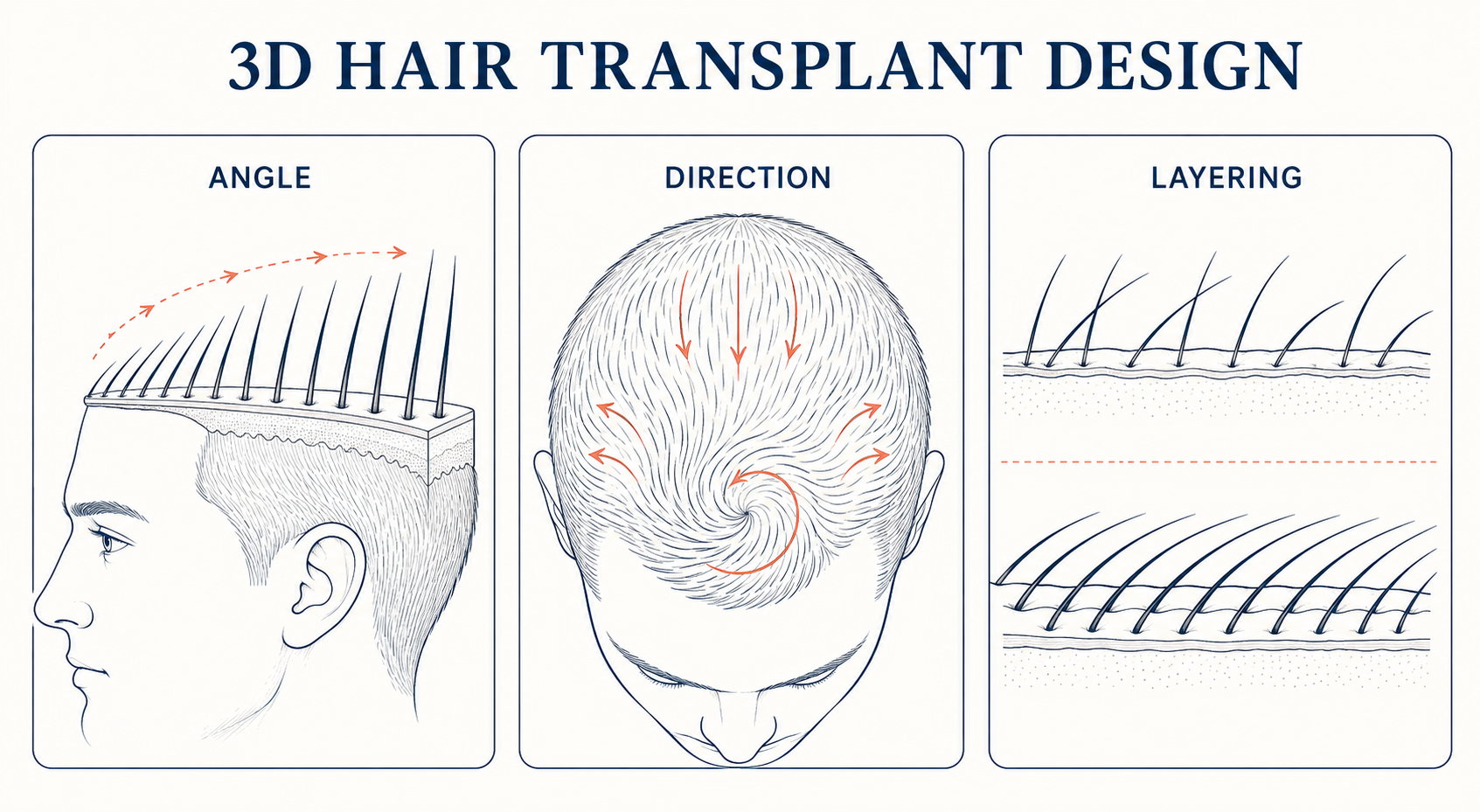
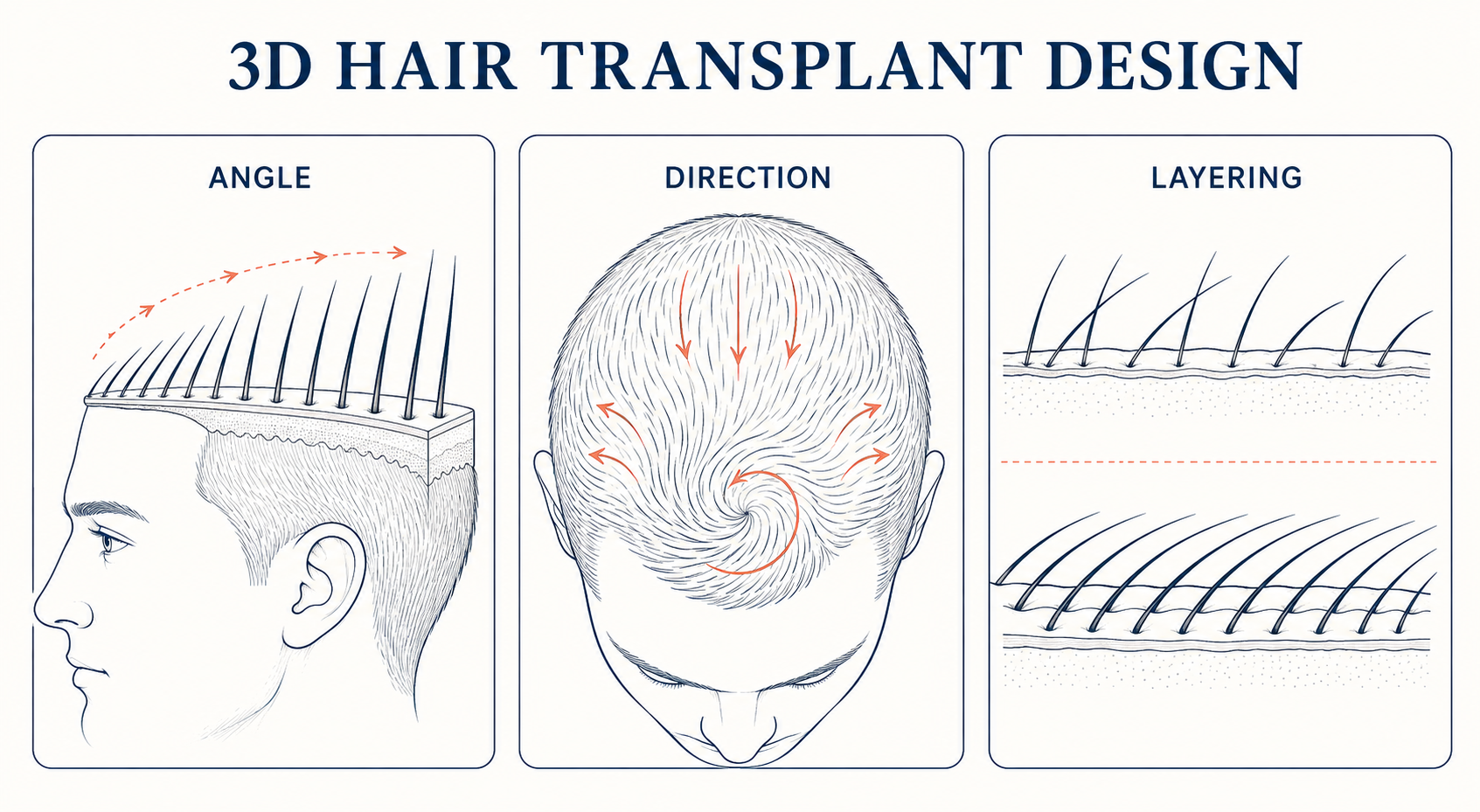
Hair does not simply emerge vertically from the scalp. It grows in changing directions, at different angles and in patterns that create layering, movement and visual density. These relationships vary across the hairline, frontal scalp, temples and crown.
At Young Hair Restoration, 3D Hair Transplant Design is the term we use to describe an individualised approach to planning these three-dimensional relationships.
It means considering not only where each follicular unit is placed, but also its direction, angle, distribution and relationship to the surrounding hair. Please note this process is very hard to perform if the head is shaved.
Hair transplantation is not simply about filling an area
It is easy to think of hair restoration as filling an empty space with as many grafts as possible. However, graft numbers alone do not determine whether a result will look natural.
Two patients may receive a similar number of grafts yet achieve very different visual results. This is because the appearance of density is also influenced by:
- Hair calibre and texture
- The number of hairs within each follicular unit
- Hair and scalp colour contrast
- The direction and angle of growth
- The distribution of grafts across the treatment area
- The relationship between transplanted and existing hair
- The progression of future hair loss
A successful design must bring these elements together rather than treating the recipient area as a flat surface.
Why direction matters
Hair direction changes throughout the scalp.
At the front, hairs generally project forward, with subtle directional changes across the hairline. In the temple regions, the hair may turn laterally and lie closer to the skin. Further back, the direction gradually changes again before forming the natural spiral or whorl of the crown.
If transplanted hairs do not follow these patterns, the result may appear stiff, disconnected or difficult to style.
Carefully planning direction helps the transplanted hair blend with existing hair and supports a more natural flow across the scalp.
Why angle matters
The angle at which hair emerges from the skin has a major influence on its appearance.
Along the leading edge of a natural hairline, hairs usually emerge at a relatively acute angle rather than standing upright. The appropriate angle then changes as the design moves through the frontal and mid-scalp regions.
Angle also affects how the hairs overlap. When correctly planned, this layering can improve the appearance of coverage without relying on excessive graft numbers.
The objective is not to reproduce one fixed angle everywhere. It is to recreate the gradual transitions normally found in natural hair growth.
Creating natural layering
Natural hair achieves coverage through overlapping layers.
This is similar to roof tiles: each layer contributes to the coverage of the layer beneath it. Hair that is placed without considering this relationship may provide less visual coverage, even when a substantial number of grafts has been used.
Three-dimensional planning considers how transplanted hairs will sit over one another once they have grown. This can help create natural movement and make strategic use of the patient’s finite donor supply.
Hair characteristics remain important. Curly, wavy, coarse or fine hair will each behave differently and therefore require an individualised design.
When Dr Young performs donor shave or Total Unshaven, the resident hair(if present) in the recipient areas, act as the ultimate natural guide.
This is nature guiding us, not some pre thought of angles and density flows.
Dr Young's thought process is allow nature to guide him.
When Dr Young performs donor shave or Total Unshaven, the resident hair(if present) in the recipient areas, act as the ultimate natural guide.
This is nature guiding us, not some pre thought of angles and density flows.
Dr Young's thought process is allow nature to guide him.
Follicular-unit selection is part of the design
Follicular units may contain one, two, three or occasionally more hairs. They are not interchangeable.
Single-hair follicular units are generally used at the leading edge of the hairline to create a softer transition. Larger follicular units can be distributed behind this area to contribute greater visual density and layering.
This is why simply advertising a graft number can be misleading. The number of hairs, their characteristics and where the different follicular units are placed all contribute to the final appearance.
Designing the hairline in three dimensions
A natural hairline is not a solid, perfectly straight line.
It usually contains subtle irregularity, variation in density and a gradual transition from finer individual hairs at the front to greater density behind. Its shape must also suit the patient’s facial proportions, age, hair characteristics and likely future pattern of hair loss.
A hairline that appears attractive immediately after a procedure must also remain believable as the patient ages.
For this reason, 3D Hair Transplant Design works alongside our concept of Sustainable Hair Restoration. The aim is to create an age-appropriate result today while carefully preserving donor hair and future treatment options.
The crown requires a different approach
The crown is one of the clearest examples of why hair transplantation must be planned three-dimensionally.
Crown hair commonly grows in a spiral or whorl, with direction changing continuously around a central point. Recreating this pattern requires careful planning and can consume a significant number of grafts.
The crown may also continue to enlarge as hair loss progresses. Restoring it too aggressively can use donor hair that may later be needed for the frontal scalp.
A responsible crown plan must therefore balance natural direction, achievable coverage and long-term donor management.
Working with existing hair
Many hair transplants are performed in areas that still contain native hair.
In these cases, transplanted follicles need to follow and support the existing direction of growth. Planning must also account for possible future thinning of the native hair.
The goal is not merely to produce an improvement at one point in time. It is to create a design that can continue to look balanced if hair loss progresses.
Medical management may therefore form an important part of the long-term plan where clinically appropriate.
Is 3D Hair Transplant Design a separate surgical technique?
3D Hair Transplant Design is not a separate type of hair transplantation or a standard medical classification.
It is the term we use at Young Hair Restoration to describe a detailed design philosophy that considers the scalp as a three-dimensional structure rather than simply an area to be filled.
The procedure may still be performed using FUE, including Total Unshaven FUE when suitable. The distinction lies in the assessment, planning, selection and placement strategy used for the individual patient.
A personalised plan matters
Every patient presents with a different combination of facial structure, hair-loss pattern, donor capacity, hair calibre, texture and long-term risk.
There is therefore no universal hairline, density pattern or graft number that will suit everyone.
A consultation with Dr Wayne Young includes an assessment of the recipient area, donor supply, hair characteristics, current pattern of loss and likely future progression. This information is used to create a personalised and sustainable restoration plan.
At Young Hair Restoration, each procedure is personally planned and performed by Dr Young, with ongoing follow-up throughout the patient’s hair-restoration journey.
Considering a hair transplant?
A natural result begins with proper diagnosis and long-term planning—not simply a graft number or a design based on photographs.
To determine whether hair transplantation is suitable for you, arrange an in-person consultation with Dr Wayne Young at Young Hair Restoration in Sydney.
Get Outlook for iOS